
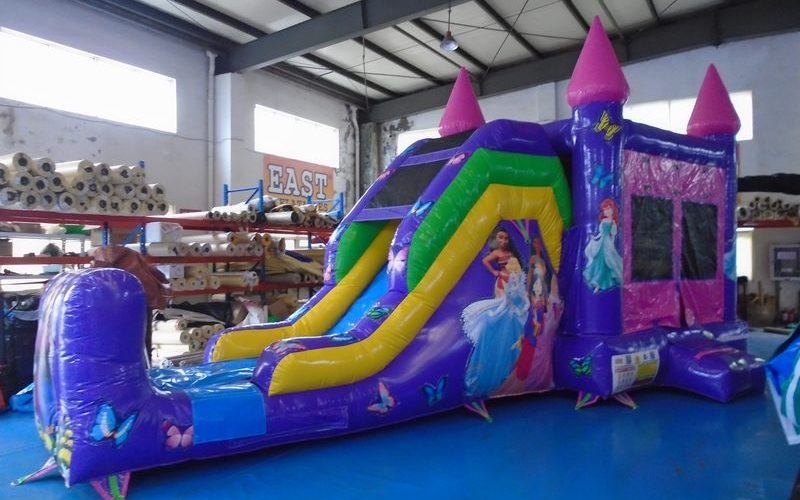
For jumping castle hire businesses across Australia, the safety and longevity of your fleet are the foundation of your reputation. In a market where equipment must endure extreme UV radiation and high weekend turnover, the difference between a “commercial-grade” unit and a “budget imitation” can be the difference between a profitable season and a catastrophic liability.
When inspecting new inventory or evaluating a potential supplier in 2026, you must look beyond the vibrant digital renders. Here are the five critical signs that an inflatable has been poorly manufactured and may not be fit for the demanding commercial hire industry.
1. Substandard Material Weight (The 0.4mm Trap)
In the Australian commercial sector, 0.55mm (18oz) PVC is the non-negotiable benchmark. Poorly manufactured units often cut costs by using 0.4mm or even thinner “Oxford cloth” materials that are designed for residential use, not professional hire.
- The “Feel” Test: If the material feels thin, overly waxy, or lightweight when folded, it likely lacks the internal polyester scrim (mesh) density required for commercial durability.
- Stretch and Sag: Lower-quality PVC will stretch under the weight of several children. If you notice the floor of the castle “sagging” or losing its tension after only a few hires, it is a sign of low-density base fabric.
- Safety Implication: Thin materials are prone to instant punctures from grass seeds, sticks, or even the friction of a “ute” tray during transport.
2. Inadequate Stitching and Lack of Reinforcement
A jumping castle is only as strong as its seams. Poor manufacturing is most visible where the vinyl panels meet, as this is where the most pressure is exerted.
- Single Stitching: If you see only one row of thread on structural seams, the unit is a “toy,” not a commercial asset. Commercial units must have at least double stitching, with quadruple stitching at high-stress points like the entrance, slide exits, and wall-to-floor joins.
- Lack of Reinforcement Strips: Professional manufacturers sew an extra strip of PVC over the internal baffles and external stress points. If the stitching is exposed directly on the main panels without these reinforcement “strips,” the thread will eventually “pull through” the PVC, causing a “bubble” or a total seam failure.
- Thread Quality: Look for frayed or “fuzzy” thread. Poorly manufactured units use cheap cotton or low-grade polyester rather than bonded, UV-treated nylon thread that can withstand the Australian climate.
3. Non-Compliant Anchor Points and Safety Features
Under AS 3533.4.1, the anchoring system is the most critical safety component of any inflatable. Poorly made units often treat anchor points as an afterthought rather than a structural necessity.
- Flimsy D-Rings: A high-quality anchor point should be a heavy-duty stainless steel D-ring reinforced with multiple layers of seatbelt-grade webbing. If the anchor points are simple “loops” of thin fabric or small, lightweight metal rings, they will likely snap during a sudden gust of wind in an open park.
- Inadequate Number of Ties: Australian standards require a specific number of anchor points based on the unit’s size and height. A poorly designed unit may lack enough tie-down points to keep it stable on a windy day.
- Entrapment Hazards: Check the safety netting. If the mesh holes are large enough for a child’s finger to get stuck, or if the gaps between the slide and the wall are inconsistent, the unit has failed basic design safety protocols.
4. Poor Blower Tube Design and Air Retention
The efficiency of the “air path” tells you a lot about the engineering and attention to detail behind the product.
- Short or Narrow Blower Tubes: Poorly manufactured units often have blower tubes that are too short or positioned at awkward angles, making it difficult to attach the blower securely.
- Excessive Seam Leakage: While all “sewn” inflatables leak some air (which is necessary for flexibility), a poorly made unit will “hiss” excessively. If the blower has to work at absolute maximum capacity just to keep the unit firm, the seams are likely too loose, which will lead to a shorter lifespan for your expensive blowers.
- Lack of Non-Return Flaps: Every commercial unit should have a “non-return” flap inside the blower tube. This ensures that if the power fails or the blower is disconnected, the unit deflates slowly rather than collapsing instantly on the children inside.
5. Fading and “Chalking” (Lack of UV Protection)
This sign often appears after the first few months of use, but it is a definitive indicator of poor manufacturing and chemical shortcuts.
- Chemical Shortcuts: Cheap PVC lacks UV stabilizers. In the harsh Australian sun, these “budget” materials undergo a rapid chemical breakdown.
- The “Chalky” Residue: If you run your hand over the PVC and it leaves a white, powdery residue (known as “chalking”), the material is disintegrating. This not only looks unprofessional but also means the tear strength of the unit is vanishing.
- Brittle Texture: Poorly made vinyl will become “crunchy” or brittle over time. A quality commercial unit should remain supple and flexible even after several seasons of use in the intense heat of Western Sydney or Queensland.
The Verdict: Why Cutting Corners Costs More
For an Australian hire business, buying a poorly manufactured inflatable is a “false economy.” While you might save a few hundred dollars on the initial purchase, the costs of constant seam repairs, the risk of a WorkSafe audit failure, and the shortened lifespan of the equipment will quickly erase those savings.
In 2026, professionalism and compliance are the keys to survival in the rental market. By identifying these five red flags—thin materials, weak stitching, flimsy anchors, poor air retention, and lack of UV protection—you can ensure that every unit in your fleet is a safe, durable, and profitable asset that meets Australian Standards.
Investing in quality-engineered equipment ensures that you aren’t just buying an inflatable; you are buying peace of mind for your clients and a more sustainable future for your business.